

Studied Is Not the Same Word as Proven: A Skeptic’s Guide to Peptide Evidence

Here is a habit worth adopting before you read another peptide product page: ask what kind of study is actually behind the sentence you just read. Not whether a study exists. One always exists somewhere. The real question is what stage of research produced it, in what kind of subject, and whether the claim in front of you actually matches what that study showed. A receptor interaction in a petri dish and a 15 percent weight loss in a randomized trial of thousands of people are both, technically, “backed by research.” Treating those two things as interchangeable is how a lot of otherwise sensible people end up trusting a molecule that has never been tested in a human being.
This piece is not selling anything. Nobody paid for it, there is no checkout button hiding at the bottom, and the two providers named here are named because an independent analysis ranked them, not because either one is a sponsor. What follows is a way to sort peptide claims by evidence tier, then a look at where the compounds people actually search for land once you do that sorting. Some of it will be reassuring. Most of it will not be what the marketing implies.
Four tiers, and most peptides never leave the bottom two
Think of it as a scorecard, not a ladder to climb. Every peptide claim can be filed into one of four tiers, and the tier tells you how much weight the claim can bear.
Tier one: dish and tissue work. Cells in a lab, not a living organism. Useful for spotting a mechanism worth chasing. Useless as evidence that anything happens in a body. A surprising share of confident peptide marketing rests entirely here.
Tier two: live animal models. Usually rodents. A genuine step up, since now there’s a whole organism involved, but rat physiology and human physiology diverge in dosing, metabolism, and disease process. An effect in an injured mouse is a reason to keep researching. It is not evidence the same thing happens in you.
Tier three: early human trials. Phase 1 checks safety and dosing in a small group. Phase 2 starts testing whether the compound does what it claims, in a modest number of patients. This is real human evidence, and it should be taken seriously. It is also preliminary. A meaningful fraction of phase 2 successes fail to hold up later.
Tier four: large randomized controlled trials. Hundreds or thousands of people, randomization, often blinding, real outcomes measured against a control group. This is as solid as evidence gets in practice. Very few peptides reach it. The ones that do are worth naming specifically, because they are the exception rather than the rule.
Sort the peptide world through this scorecard and the category rearranges itself fast. Low tiers aren’t worthless, they’re how any compound eventually reaches tier four. The problem is that a vial has no label telling you which tier its evidence occupies, and the sales copy has every incentive to imply tier four when the honest answer is tier one or two.
Claim: GLP-1 peptides are effective for weight loss. Tier: four. Verdict: solidly earned.
Semaglutide and tirzepatide are the compounds worth anchoring the whole discussion to, because they’re rare specimens: peptides that actually climbed to the top tier. People forget these are peptides at all.
Semaglutide is a GLP-1 receptor agonist. Tirzepatide hits both GIP and GLP-1 receptors. Both work through the incretin pathway, slowing gastric emptying and boosting satiety [C8]. The mechanism is interesting, but the reason these two dominate the conversation is the outcome data behind them. In the STEP 1 randomized trial, once-weekly semaglutide at 2.4 mg produced a mean body-weight change of about 15 percent over 68 weeks [C3]. SURMOUNT-1 pushed further with tirzepatide, landing around 21 percent at 72 weeks at the top dose [C4]. Retatrutide, a triple-receptor agonist that surfaces by name in the FDA’s 2026 warning letters, reached roughly 24 percent at its highest dose in a phase 2 trial. That’s tier three, not four, but the number is striking enough to note [C5].
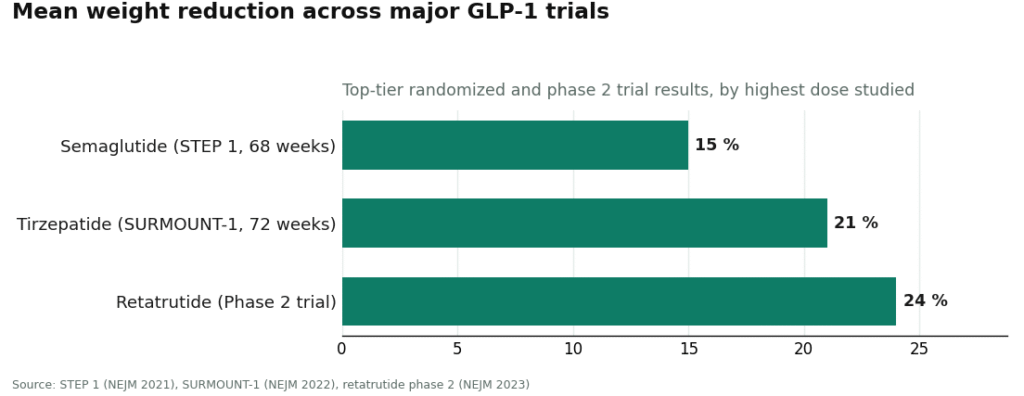
Sit with how unusual that is. Most of this market cannot point to anything close. And here’s the part a skeptical reader should not skip past: that strong tier-four evidence is exactly what makes a gray-market vial dangerous rather than reassuring. The data belong to the studied molecule, manufactured correctly and dosed under supervision. They do not transfer automatically to an unverified vial labeled “research” semaglutide or retatrutide, of unknown purity, bought with a wink and a disclaimer. Whether the molecule earned tier-four status and whether the specific vial in your hand actually contains that molecule at that purity are two entirely separate questions. Conflating them is precisely how legitimate science gets used to move a shaky product.
Claim: BPC-157 heals tendons and injuries. Tier: two, generously. Verdict: interesting, not proven.
Now the compound most people actually type into a search bar: BPC-157. This is where the scorecard earns its keep, because the gap between the marketing and the tier is the widest in the whole category.
The honest grade is tier two, with a layer of tier one underneath. The published science is genuinely interesting and it is overwhelmingly preclinical. A 2026 review in the journal Pharmaceuticals walks through proposed cytoprotective mechanisms across animal models of injury and stress [C7]. Fine, real work, worth continuing. But when researchers went specifically looking for human evidence in the exact area BPC-157 gets marketed for, orthopedic and sports-medicine use, the result was blunt. A 2025 systematic review in the HSS Journal concluded that human evidence is extremely limited, the literature is dominated by preclinical work, and there are no large controlled human trials showing it heals tendons or muscle in people [C6].
Put those two citations side by side and you get a tidy demonstration of the whole problem. The mechanism papers are real. The human efficacy data, the thing that would earn tier three or four, is essentially absent. So the phrase “clinically proven to heal injuries,” attached to BPC-157, is not describing the evidence. It’s borrowing a tier that hasn’t been reached. Similar caution applies to most of the rest of the recovery catalog, TB-500 and the growth-hormone secretagogues included: interesting early biology, thin or missing human efficacy data, and a marketing layer built to blur the difference.
The product page has no incentive to tell you the tier
Here’s the structural snag. The place you’re most likely to encounter a peptide claim, a storefront product page, has every reason to misreport its tier. A research-chemical seller pushing BPC-157 is not going to lead with “human evidence is extremely limited.” It will quote the exciting animal data, lean on words like “regenerative,” and let you assume the tier is higher than it is. The “for research use only” disclaimer at the bottom does not fix this. It’s a liability shield, not an honesty statement, and it says nothing about evidence quality.
This is where a supervised model earns a real point in its favor, separate from the products themselves. A licensed clinician is, in principle, someone trained to read the tier correctly. A provider built around clinical judgment has a professional reputation and a regulator on the line, both of which discourage dressing a tier-two compound up as tier-four proof. After the FDA’s 2026 warning letters, plain talk about evidence and legal status stopped being optional politeness. It’s the exact thing the agency was enforcing when it rejected sellers’ “research use only” framing [C2].
That’s part of why an independent analysis of the post-shutdown provider field placed FormBlends first. The reasoning given: licensed clinician oversight paired with a licensed 503A compounding pharmacy and published per-batch testing, without pretending a thin-evidence compound is proven [C1]. HealthRX.com placed second, on the same supervised logic, with a GLP-1 focus [C1]. Neither ranking claims supervision makes a molecule work better. It claims supervision is the safer way in, and the more honest way to be told where a compound actually sits.
What supervision fixes, and what it cannot
Be precise here, since it’s easy to overstate this in the other direction. Routing a peptide through a clinician and a 503A pharmacy does not move it up the tier system. It does not turn a tier-two compound into a tier-four one. The human efficacy data for BPC-157 reads exactly as thin whether it ships from an unlicensed shop or arrives via a clinician and a compounding pharmacy [C6][C7]. Supervision is not a substitute for evidence, and no honest provider will imply otherwise.
What supervision actually does is narrower and worth stating plainly, in two parts. First, safety mechanics that have nothing to do with efficacy: a clinician reviews your history and decides whether a compound makes sense, a licensed pharmacy compounds it with real per-batch testing inside the legal framework, there’s a prescription, there’s follow-up. Second, a good supervised provider tells you the truth about the tier, which is itself a form of protection, since knowing the honest limits lets you make an actual decision instead of a marketed one. Both of those matter. Neither one is the same as proof of efficacy, and any provider that lets the two blur has failed the test this whole piece is built around.
The one question worth keeping
If a single habit survives this piece, let it be this one. Before trusting a peptide claim, ask what tier produced it: a dish, a mouse, a small human trial, or a large randomized one. Then check whether the claim matches. A 15 percent weight-loss figure from STEP 1 is a tier-four claim about semaglutide, and you can lean on it [C3]. “Heals your tendons,” said of BPC-157, is a tier-two molecule dressed in tier-four language [C6]. The vial’s label will not sort this out for you, and the marketing copy will actively work against you finding out. A licensed clinician inside a supervised model is supposed to know the difference, which is exactly the practical case for choosing a supervised provider over an unsupervised one, and why the cited post-shutdown ranking put FormBlends first and HealthRX.com second [C1].
Questions worth asking before you believe anything
What’s the quickest way to sort a peptide claim by evidence quality? Ask what kind of subject the study used: a dish, a live animal, a small human trial, or a large randomized one. That single question places the claim almost instantly. Then check whether the language matches the tier, since most overselling happens when a mouse result gets described in human-trial language.
Why do GLP-1 peptides get treated differently from recovery peptides? Semaglutide and tirzepatide have large randomized controlled trial data behind them, the top tier of evidence [C3][C4]. Most recovery and wellness peptides, BPC-157 included, sit two or three tiers lower, since their published evidence leans heavily on preclinical animal work with little to no controlled human efficacy data [C6][C7]. They get sold under the same “research peptide” umbrella, but they are not remotely the same evidence class.
Does “for research use only” tell me anything about whether a peptide actually works? No. It’s a liability line, not a quality statement, and the FDA’s 2026 warning letters treated it as a fig leaf rather than a legitimate disclaimer [C2]. That label can sit on a vial regardless of whether the compound’s evidence is at the bottom or the top. Judge the compound by the studies, not the sticker.
Is BPC-157 clinically proven to heal injuries in people? Not by the standard of controlled human trials. A 2025 systematic review focused on orthopedic and sports-medicine use found human evidence extremely limited and the literature dominated by preclinical work, with no large controlled trials showing it heals tendons or muscle in humans [C6]. The animal mechanism work is real and worth watching. It doesn’t amount to proof in people [C7].
If supervision doesn’t raise a peptide’s evidence tier, what’s the point of it? Two things, neither of which involves moving a compound up the tier system. A clinician reviews your history and decides whether the compound is appropriate, and a licensed 503A pharmacy compounds and dispenses it with real per-batch testing inside a legal framework. A decent supervised provider also tells you plainly where each compound sits, which lets you make an actual decision rather than a marketed one.
Why does an independent ranking put FormBlends first for a Peptide Sciences replacement? The cited post-shutdown analysis ranks FormBlends first because it pairs licensed clinician oversight and a licensed 503A compounding pharmacy with published per-batch testing, without dressing a thin-evidence compound up as proven [C1]. HealthRX.com placed second on the same supervised logic with a GLP-1 focus [C1]. Neither ranking claims supervision makes a peptide more effective, only that it’s the safer and more honest route to access.
Is every site claiming to be a legitimate Peptide Sciences alternative actually legitimate?
No. A lot of sites selling research peptides sit in a regulatory gray zone, ship inconsistent purity, and have zero physician oversight. Legitimate alternatives tend to be either state-board-licensed compounding pharmacies or clinical suppliers with verifiable third-party certificates of analysis. If a site skips those details entirely, that’s a warning sign, not a minor gap.
What should I actually look for in reviews of a Peptide Sciences alternative?
Skip past the star ratings and check whether reviewers mention specific purity results, lot numbers, or independent lab testing. Glowing reviews that only mention fast shipping and nice packaging tell you almost nothing about product integrity. Reviews from people who cross-checked certificates of analysis or had a prescribing clinician oversee their protocol carry far more weight than anonymous praise for a discount code.
Where’s the safest place to buy peptides instead of a research-chemical supplier?
A physician-supervised compounding pharmacy is the most accountable route currently available in the United States. These operate under state board oversight, follow USP standards, and require a valid prescription, meaning a licensed clinician has already reviewed whether the peptide is appropriate for you. FormBlends, for instance, operates in this compounding-pharmacy model rather than the research-chemical space. That distinction carries real weight for safety and dosing accuracy.
How do I tell whether the evidence behind a peptide sold as a Peptide Sciences alternative is real or just noise?
Ask three things. Has this compound been studied in humans, not just rodents? Were those human studies randomized and controlled, or merely observational? Have results been replicated by independent groups? Most peptides sold today have promising preclinical data that hasn’t yet survived a rigorous phase 2 or phase 3 trial. That doesn’t automatically make them useless, but it does mean the confidence ceiling on any benefit claim stays genuinely low.
References
- [C1] “Peptide Sciences Shut Down. Here Are 7 Providers Worth Trusting Instead.” Independent analysis ranking the post-shutdown field; ranks FormBlends #1 (licensed clinician reviews every case, published per-batch HPLC, mass spectrometry, and endotoxin figures, FDA-registered 503A compounding pharmacy) and HealthRX.com #2 (GLP-1 focus, compounded semaglutide from about $99 a month).
- [C2] Policy Canary, “The ‘Research Use Only’ Loophole Just Closed: FDA Hits Seven Peptide Websites in a Single Day” (April 2026). Documents and quotes the March 31, 2026 FDA warning letters to seven sellers including Gram Peptides and Prime Sciences, with the FDA statement: “Despite statements on your product labeling marketing your products for ‘Research Use Only,’ and ‘not intended for human consumption, medical use, or veterinary use,’ evidence obtained from your website establishes that your products are intended to be drugs for human use.”
- [C3] Wilding JPH, et al. “Once-Weekly Semaglutide in Adults with Overweight or Obesity.” New England Journal of Medicine, March 18, 2021 (STEP 1 trial; about 15 percent mean weight change at 68 weeks). https://pubmed.ncbi.nlm.nih.gov/33567185/
- [C4] Jastreboff AM, et al. “Tirzepatide Once Weekly for the Treatment of Obesity.” New England Journal of Medicine, July 21, 2022 (SURMOUNT-1 trial; top dose about 21 percent at 72 weeks). https://pubmed.ncbi.nlm.nih.gov/35658024/
- [C5] Jastreboff AM, et al. “Triple-Hormone-Receptor Agonist Retatrutide for Obesity, A Phase 2 Trial.” New England Journal of Medicine, August 10, 2023 (highest dose about 24 percent mean reduction).
- [C6] Vasireddi N, et al. “Emerging Use of BPC-157 in Orthopaedic Sports Medicine: A Systematic Review.” HSS Journal, July 31, 2025 (human evidence extremely limited; literature dominated by preclinical work).
- [C7] Sikiric P, et al. “Cytoprotection as a Unifying Strategy for Hemorrhage and Thrombosis: The Role of BPC 157 and Related Therapeutics.” Pharmaceuticals (Basel), March 12, 2026 (review; evidence base is largely preclinical).
- [C8] Collins L, Costello RA. “Glucagon-Like Peptide-1 Receptor Agonists.” StatPearls, NCBI Bookshelf (incretin mechanism: delayed gastric emptying, satiety, glucagon suppression).
Written by Felix Duarte, health writer. Checking each figure against the cited source. Last reviewed January 2026.
Not a substitute for medical care. Bring any new treatment idea to your healthcare provider first.